
WTO finds shipments through Hormuz still near zero five months on, with 18 economies, seven of them least developed, most exposed.
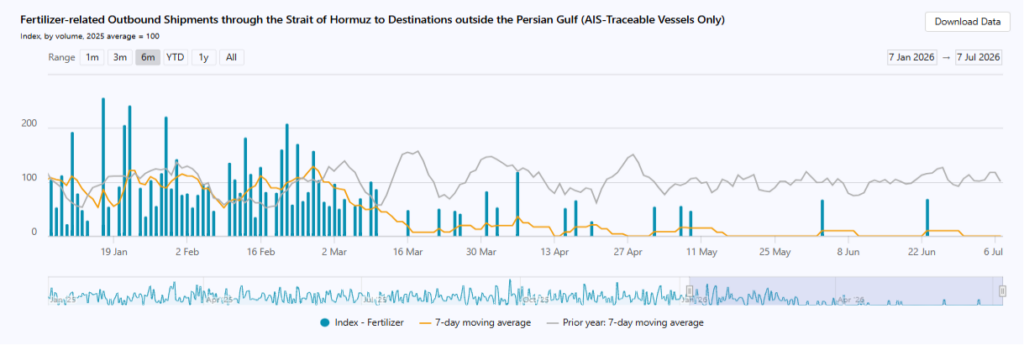
Fertiliser shipments out of the Persian Gulf have been close to zero since the Strait of Hormuz closed in the opening weeks of the conflict, and had not resumed on any stable basis by early July, according to analysis published by the World Trade Organization on July 10.
The Secretariat’s vessel-tracking data show outbound fertiliser cargoes bound for destinations beyond the Gulf falling to a standstill within days of the February outbreak and staying there. Its count excludes ships that have switched off their transponders, so the true figure is somewhat higher.
Prices tell a less alarming story than the volumes. Urea, trading at about $400 a tonne before the war, passed $850 in April before falling back to $453 in June. Diammonium phosphate rose from roughly $580 to about $770. Both remain below their 2022 peaks, when urea briefly topped $900, DAP approached $960 and potash exceeded $1,200.
The gap between collapsed volumes and moderating prices reflects how narrow the affected slice is. Gulf producers supply 24.8 per cent of world nitrogenous fertiliser exports and 11.4 per cent of phosphatic exports, but almost nothing in potash. Russia, China and Morocco account for much of the rest, and none of them ships through Hormuz.
Exposure is concentrated rather than general. India draws almost two-thirds of its nitrogenous fertiliser imports from the Gulf and Thailand close to half. Asian buyers take 40 per cent of the region’s nitrogen exports and 48 per cent of its phosphates.
The Secretariat identifies 18 economies that combine heavy overall import dependence with heavy reliance on Gulf suppliers. That is roughly a fifth of the 81 economies buying from the region, and seven of the 18 are least developed countries. The list is dominated by sub-Saharan Africa: Kenya, Malawi, Mozambique, Rwanda, South Africa, Tanzania, Uganda and Zimbabwe. Brazil, Nepal and Sri Lanka also appear.
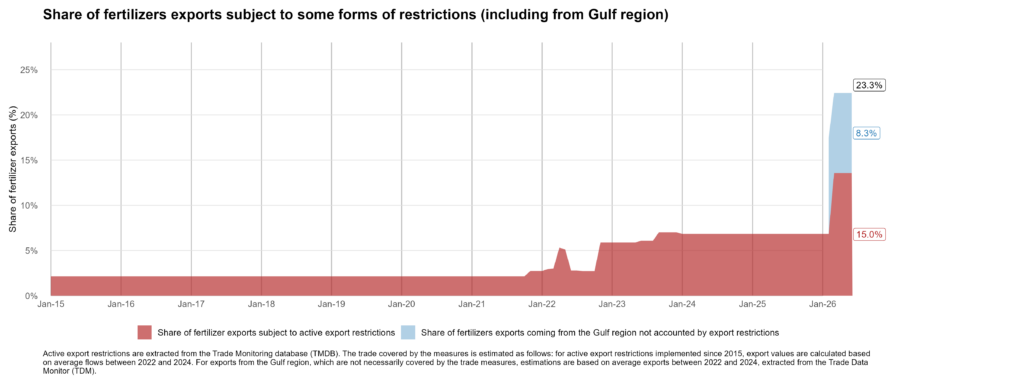
Policy has compounded the physical shock. Export licences, restrictions and outright bans now cover as much as 15 per cent of world fertiliser exports, against a negligible share before the closure. Treating the strait itself as a de facto restriction on everything leaving the Gulf lifts the figure to 23.3 per cent, though the Secretariat is careful to present that as a ceiling rather than an estimate of lost trade: licensing is not prohibition, and some Saudi volumes have moved through the Red Sea port of Yanbu at higher cost.
China tightened controls on urea and sulphuric acid before permitting limited urea exports under quota. Russia extended its fertiliser export quotas and suspended export licences for ammonium nitrate. Türkiye banned sulphur exports temporarily. That measure targets an input rather than a finished product, but it reaches phosphate output all the same, since sulphuric acid is required to make DAP and monoammonium phosphate.
What is striking, for a trade shock of this size, is how little the tariff instrument has to do with it. Close to 60 per cent of members’ fertiliser tariff lines are already duty-free and applied rates average below 2.5 per cent across every product group, so the import-side liberalisation announced in response gives away very little: the European Union has suspended fertiliser duties for all origins except Russia and Belarus, and Türkiye has lifted them on urea. The binding constraints are physical closure and export controls.
That is the awkward part. Members retain substantial legal headroom on the import side, with nearly 80 per cent of fertiliser lines bound above 5 per cent, more than 40 per cent bound above 20 per cent and about one subheading in five not bound at all. On the export side the disciplines are thinner. GATT Article XI permits temporary export prohibitions to relieve critical shortages, and the Agreement on Agriculture’s notification and consultation requirements attach to foodstuffs, which fertilisers are not.
Spending has filled the gap. The European Commission has adopted a fertiliser action plan backed by €540mn from its agriculture crisis reserve, alongside a temporary state aid framework under which Spain has committed €500mn and France up to €145mn. India revised subsidy rates under its $4.5bn nutrient-based scheme for the monsoon crop and has ring-fenced natural gas for fertiliser plants at no less than 70 per cent of their average consumption. Kenya, Ghana, Sri Lanka, Armenia and Thailand have all increased distribution budgets, and Washington has announced plans to expand domestic production.
Whether any of it is needed for long depends on the strait. The Secretariat’s data run only to July 7 and show no durable resumption; its conclusion is that reopening would in due course ease the frictions and let members unwind the restrictions they have introduced. That assumes the interruptions stop, which on the evidence of the weeks since is not yet safe to assume. Reported strikes on commercial shipping and repeated closures have kept war-risk premiums and freight costs elevated, and each fresh interruption pushes back the point at which any of the export controls come off. Continued fighting, further disruption at the chokepoints and an intensifying El Niño, arriving as margins are already compressed by input costs that farm-gate prices have not matched, are the complications nobody has a trade instrument for.